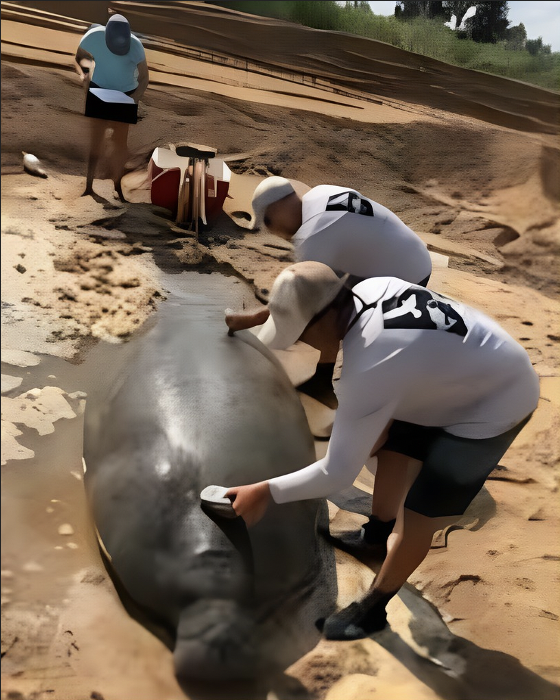
Stranded Manatee
By R.J. Smiley
What started as a quick Saturday morning round before kickoff became a reminder that golf is often played on nature’s schedule – not ours.
It was November 22nd, the kind of crisp low country morning when the ball doesn’t spring off the club face and the marsh grasses whisper a low-pitched song in the breeze. The twosome, hoping to finish before the National Anthem, was making its way down the ninth hole when something in the water hazard caught their eye – something that clearly did not belong.
At first it looked like a log shifting in the mud. Then the shape rolled. A broad gray back surfaced, followed by a slow labored breath. This was not debris. It was a living, breathing manatee – far from where it should have been.
Stranded and struggling in the shallow marsh at low tide, the manatee appeared vulnerable. Phones came out immediately. One golfer dialed the South Carolina Department of Natural Resources (SCDNR). The other contacted golf course staff. Within minutes, what began as a quick round became a coordinated rescue effort. It was later described like assessing a tricky golf shot: pause, gather information, and choose the right approach, proceed.
SCDNR biologists, aided by live cellphone video, evaluated the situation remotely while Crescent Pointe staff mobilized on site. Marketing Director Dylan DeBellis was among the first to arrive, joined by community volunteers. Golf carts buzzed back and forth like an old-time bucket brigade, ferrying water to the scene. Damp towels were carefully draped and misted over the manatee’s thick skin, keeping it moist without chilling the animal. The goal was simple and precise: stabilize, don’t stress; help, don’t interfere.
The manatee was showing early signs of distress. By this point in the year, most manatees have already migrated south toward Florida’s warmer waters. These gentle giants are cold-sensitive; when water temperatures dip below about 68 degrees, they can suffer cold stress, which weakens their immune systems and can prove fatal. With thin blubber, slow metabolism, and limited endurance out of water, a wrong move – even by well-meaning humans – can do more harm than good.
Manatees are increasingly showing up in South Carolina waters. More than 230 sightings have been reported statewide in 2024 alone. During warmer months, they travel north along the Atlantic coast, following seagrass beds and freshwater outflows. Estuaries like those surrounding Bluffton with tidal creeks, marshes, and golf-course-adjacent ponds can appear welcoming, especially at high tide. The danger comes when tides fall quickly leaving stranded animals that don’t realize their exit route is disappearing behind them.
Back on the course, the ninth hole was closed as the ranger rerouted play. Golfers understood instinctively that this was a moment for quiet respect, not crowds of picture-takers or curiosity seekers. It was a subtle reminder that golf is a game played in harmony with nature, not one meant to interrupt it.
As mid-morning sun slipped into early afternoon, the tide began to turn – literally. Water crept back into the marsh channels. The manatee, estimated to weigh between 800 and 1,200 pounds, shifted, tested the depth, and finally found enough buoyancy to move. Slowly, almost with a sense of gratitude, the unique creature slipped into deeper water and vanished toward the larger tidal system beyond the fairways.
No nets were needed. No relocation. Just time, teamwork, and restraint.
SCDNR’s Cheyenne Twilley later emphasized how close the situation had been. Left alone without intervention, the manatee could have suffered dehydration, cold stress or worse. “This was exactly the kind of response we hope for,” she noted – quick reporting, minimal handling, and patience.
For Crescent Pointe, the day became more than a story, it became a symbol. In Bluffton’s coastal crossroads, where fairways edge estuaries and herons often outnumber golfers, the rescue underscored the greener side of the game. Golfers talk often about course management. On this Saturday, they discussed management shaped by tides, timing, and care.
As the manatee disappeared into the murky waters, one golfer turned to another and said, “There’s no room on the scorecard for a story like that.”