Scooping – Good For Ice Cream, Bad For Golf
By Greg Schulze, PGA Master Professional of Player Development
One scoop or two? How do order your ice cream cone? “Scooping” is delicious for ice cream, but debilitating for your golf game!
“Scooping” is a commonly used golf term to describe a POOR CONCEPT in getting the ball airborne. Scooping takes hold when golfers first began to play before an alternative learning approach is introduced activating “bad instincts.” Any degree of attempting to “slide the clubhead under the ball” falls under the scooping misconception. During lessons, I often assign a “scooping scale” value from 1-10 to measure my client’s current levels of scooping. Raising this core as high as possible is our first and only priority at this point.
Scooping leads to an inconsistent low point of your swing circle/impact, ranking ahead of direction or distance. Airborne clarity first, then airborne and straight, then airborne, straight, and far, in that order. If/when scooping is allowed to continue, each swing becomes a long-term damaging attempt to match up a matrix of compensations hoping they will “cancel” each other out by the moment of impact. Does that sound like a long-term plan for consistency?
Compensations And Consistency Do Not Co-Exist
Don’t be fooled, every once in a while, the ball will shoot off the ground with a few ending up near the intended target, (sometimes the “stars” do line up!), but these are FALSE POSITIVES, and damaging reinforcements for long-term progress and consistency.
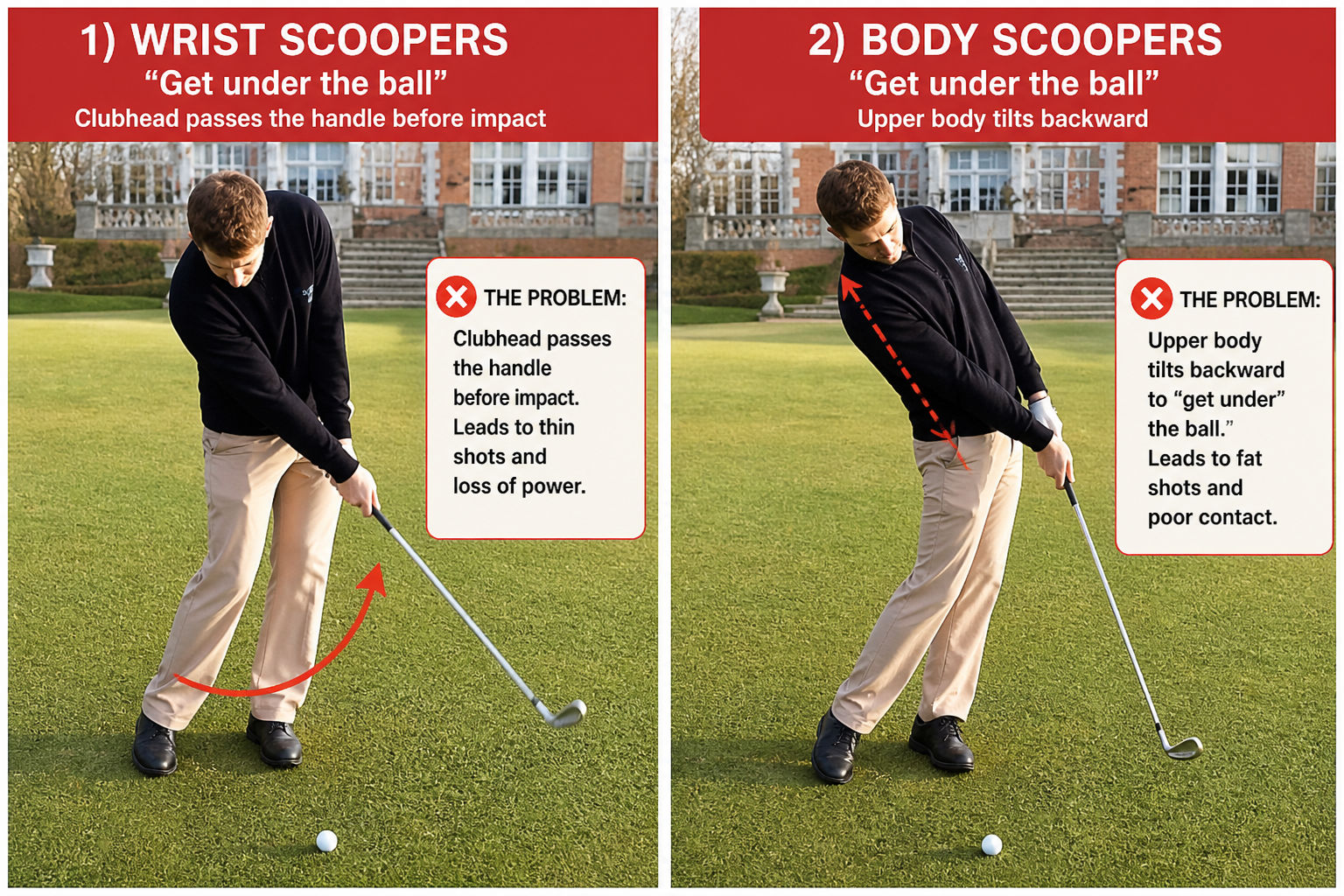
There seems to be two primary kinds of “scoopers.”
- “Wrist Scoopers” who make attempts to “get under the ball” allowing the clubhead to pass the handle before impact.
- “Body Scoopers” who TILT their upper body’s backward in an attempt to “get under the ball.”
Golf seems to “love” building its own jargon and you may have heard golf shots labeled “fat” or “thin.” Both these terms describe and are caused by scooping; they simply have different degrees of timing. Enjoy your ice cream but seek guidance from your PGA Professional if you would label yourself a “scooper.”